
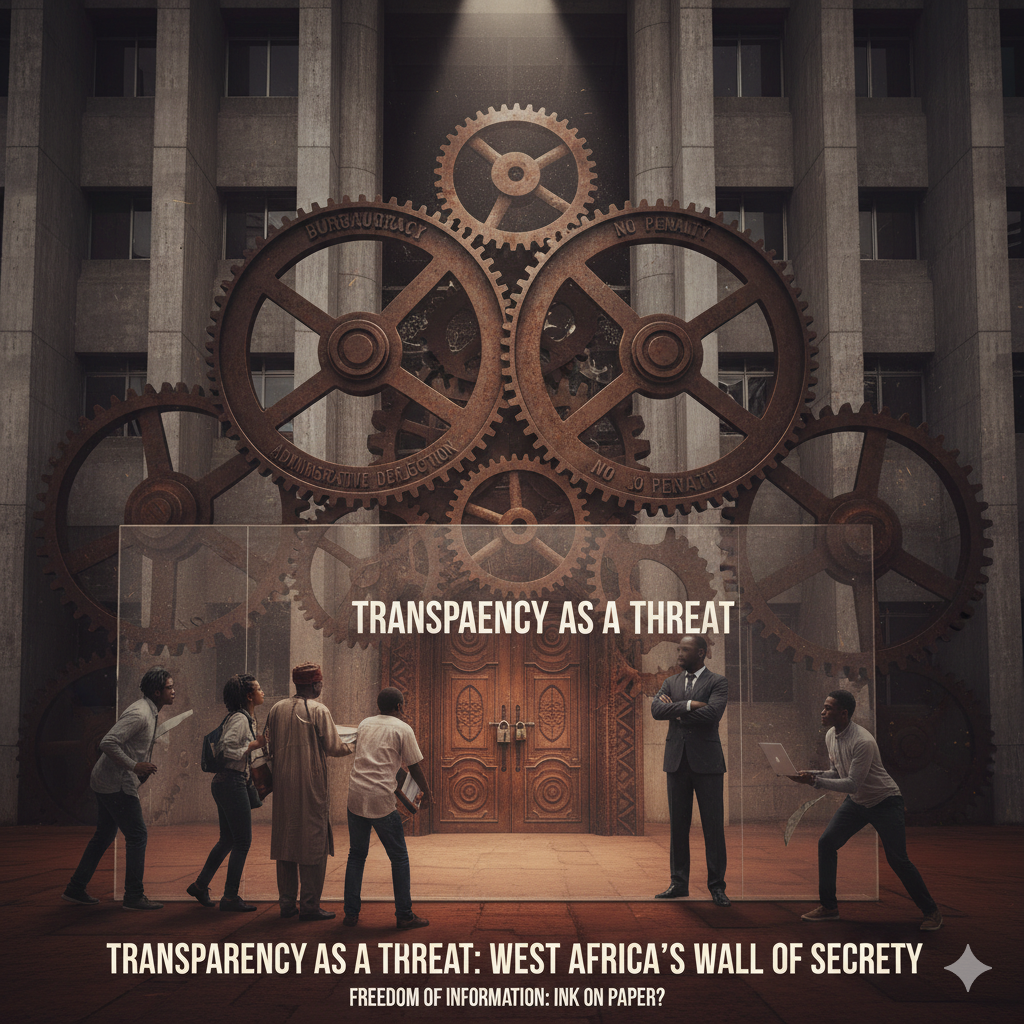
TRANSPARENCY AS A THREAT RATHER THAN A SERVICE
Freedom of information is a legal provision that gives people “the right to know”. This provision is weakly implemented in highly corrupt countries. The oldest Freedom of Information Act is Sweden’s Freedom of the Press Act of 1766. However, Sweden maintains a prudent general data protection regulation (GDPR) approach that distinguishes between personal privacy and publicly accessible information. Public Administration in West Africa has gradually moved away from the gold standard.
Ghana and Nigeria are two different countries. The experiences of each of the two different individuals who visited government-owned establishments in each of the countries are the same. The current climate in Nigeria and Ghana often treats public information as a state secret.
Most public institutions in West Africa seem to be resting on the giant pillars of secrecy. This happens regardless of the existing legal provisions that give people the right to know. Here is the friction; there is hesitation by government workers who usually do not oblige to provide data to the public. In Ghana, access to information is approved under the Right To Information Law of 2019, whereas in Nigeria it is guaranteed under the 2011 Freedom of Information Act (FOIA). While it is Ghana’s independent Right To Information Commission responsibility to oversee the law, it is the office of the Attorney-General that oversees the FOIA in Nigeria. Having a high office as the oversight body, creates a psychological and administrative barrier between the everyday person and process of social enquiry. Passing a socially relevant bill into law is an excellent score, but a law that requires multi-layered implementation approach is potentially a miscalculation. People will continually face considerable levels of resistance or hesitation in the process.
When seeking information from public institution in Nigeria, the request process must be made in writing (electronically or via letter), clearly describing the information needed. I recall in 2020 and in 2024, I sent separate emails to the Nigerian embassy and the Nigeria communication commission respectively. Going by the law, public institutions are “mandated” to respond within 7 days of receiving a request. In 2026, I am yet to receive any response. As a mere compatriot, it is likely my email address is not “mandamous” enough to persuade a response. Enacting a freedom of information law without penalty for non-compliance is essentially a suggestion presented as an ink on a paper. The workability mechanisms of these laws is not strong enough to transition enactment to practicability. This leaves the system in a circular motion of bureaucratic threat against transparency.
Sometime ago, a social enquiry was made to one of Nigeria’s education board concerning university matriculation registration regulations. The response published by the office of the Board’s registrar describes the enquirer as an “unscrupulous self-styled education advocate…attracting traffic to their social media platforms”. This is arguably a disrespectful comment and a politically motivated reasoning. It is a classic defensive mechanism used by certain public office holders as Administrative Deflection. Such ineffective management of public enquiries raises concern that public institutions are under the spell of micro-management and thus, they consider transparency as a threat. Clarity is an attribute of transparency and it should be treated as a service rather than a threat to be managed.
Social enquiries appeal to public interest and speed up social change. However, it requires a creatively supportive and improved mechanism to drive a positive change. Journalists, social entrepreneurs and other curious enquiries have been relegated to outsource information from a “quick search” machine even though such information are not truly representative of some specific aspect of certain enquiries. Public participation would fade when accountability suffers for lack of cooperation and transparency. Public institutions should not continue to run on the fuel of micro management, controlled by public authorities. They should embrace the feedback loop and not interpret criticisms as an attack. For private-owned businesses, the feed-back culture is used as the pivot to improvement.
As Ghana continues to enjoy position number 43 on the 2025 corruption index, Nigeria must seek redress and improve from its 26th position on Transparency International’s corruption index. When the authorities let the facts speak, they will spend fewer resources curating narratives to plead its cause before the global community.
Written By: Byke Freeborn|X/Twitter: @bykefreeborn