
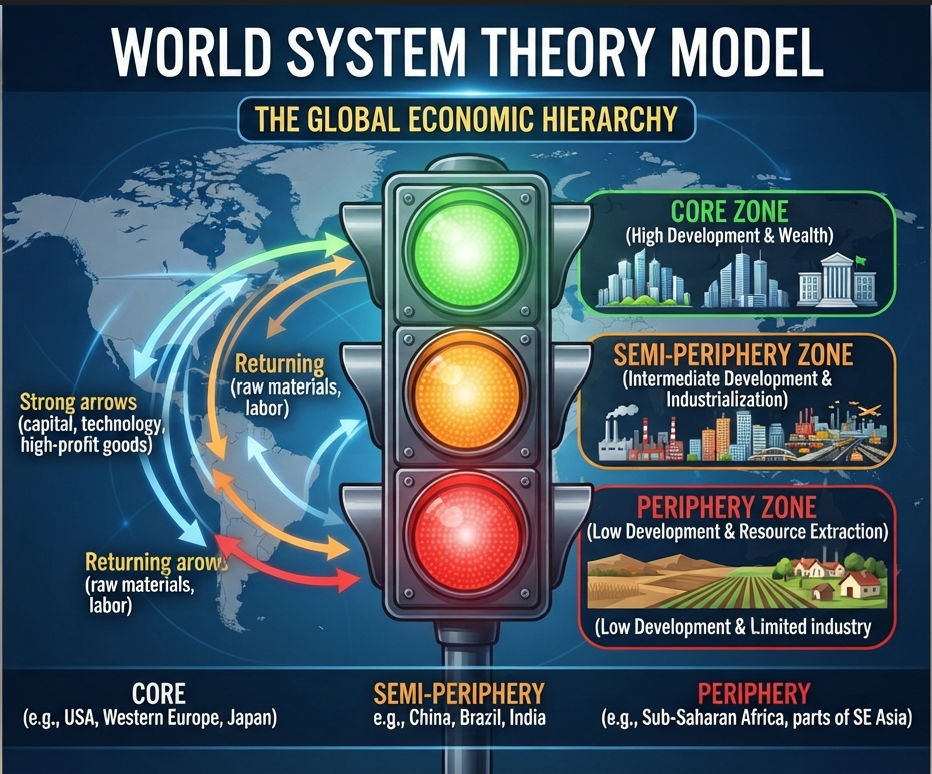
Following World War II, scholars began searching for the root causes of underdevelopment in Latin American countries. This inquiry led to the formulation of Dependency Theory, which posits that resources flow from a “periphery” of poor and exploited states to a “core” of wealthy states, thereby enriching the core while further impoverishing the periphery. It argues that periphery states are integrated into the “World System” in a manner that inherently disadvantages them.
The World System is an aggregate structure representing the interaction of states within an interconnected global network. It is not necessarily a single global system; rather, it consists of blocs larger than any individual state—for instance, regional socio-economic blocs interacting across borders. States within a bloc may form a “natural group” if their populations share kinship networks or historical, cultural, or ideological identities. Conversely, they are an “artificial group” if they are linked primarily by socio-economic interests. Within this interconnectedness, each state adopts defined roles, boundaries, and structures, providing the basis for systems theory.
Within this World System, the primary resources flowing from the periphery to the core include agricultural products, cheap labor, raw materials, and human capital (brain drain). This exchange is typically unequal due to technological differentials and imbalances in power dynamics. This unequal interaction establishes a strict hierarchy between core and periphery states.
In an interconnected world, most core states share geographical proximity. The regions where the core meets the periphery constitute the “semi-periphery”—areas of intermediate development that serve to stabilize the international system. For example, when conflict minerals move from a mining site to a region where they are rebranded before being shipped to an international hub, the process interacts with all three levels of the system: the periphery, the semi-periphery, and the core. When the periphery sells raw materials cheaply to the core and subsequently purchases expensive, finished goods from the core, there is a clear winner and a loser.
Ultimately, because we exist within this interconnected global structure, the notion that individual success is solely a product of personal ability is questionable. Individuals who fail to achieve success do not fail due to a lack of capacity alone; they are also navigating the constraints of a system designed to favor the core. These structural theories suggest that the narrative which attributes success solely to individual effort is often incomplete. As we continually acknowledge that failure is partly a by product of systemic placement and geographical positioning, we must shift from the notion that global inequality requires only individual upskilling.
Written By: Byke Freeborn| X/Twitter: @bykefreeborn